
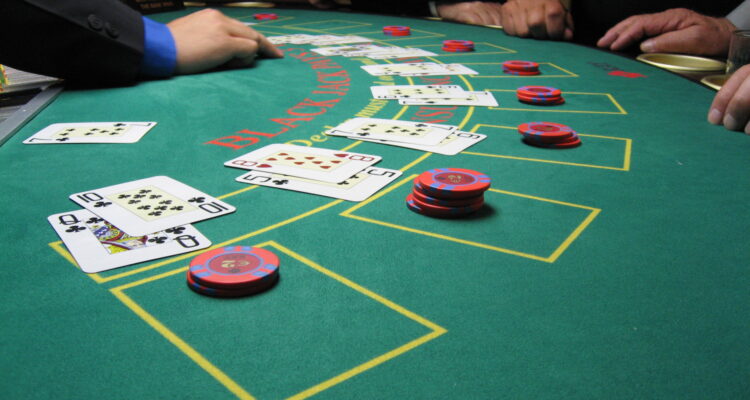
What makes blackjack different from most casino games is that the maths is visible if you know where to look. Cards are exposed. Decisions are discrete. Outcomes feel personal. The result is a game that has been studied more than almost any other form of gambling. That’s because its structure is unusually transparent.
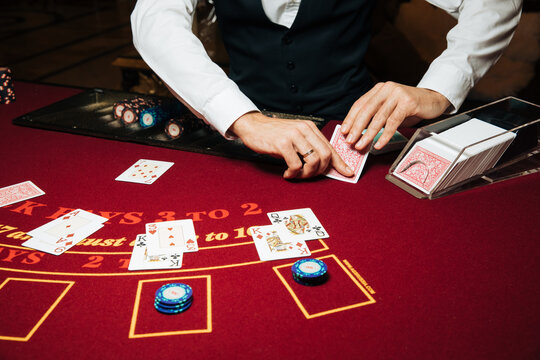
Blackjack is also widely available, both in physical casinos and online, where accounts with reputable platforms like Betway allowing players to play these games through a standard Betway login have made the rules familiar to a much broader audience. That accessibility has helped turn blackjack into a kind of public classroom for probability, even for people who would never describe themselves as interested in mathematics.
Why the dealer always acts last
The most important rule in blackjack is also the simplest one. The dealer acts after the player. On the surface, this looks generous. In practice, it is the backbone of the house edge.
When a player goes over twenty one, the hand ends immediately. The dealer does not need to draw another card. This is known as player busting first, and it matters because the dealer can only lose after the player has already survived their own decisions. Mathematically, this creates an asymmetry that favours the house even before any other rules are applied.
A useful way to think about this is to imagine a tennis tie break where one player loses the point the moment they hit the ball out, while the other is allowed to keep serving until the rally finishes. The rule does not feel dramatic. The effect accumulates quickly.
The maths hiding in plain sight
Blackjack probability is shaped by finite decks, not endless randomness. Every card removed changes the odds of what remains. This is why the game attracted mathematicians long before it attracted movie directors.
In a standard multi-deck game, the probability of drawing a ten-value card is higher than any other rank because tens, jacks, queens, and kings are all valued at ten. This simple imbalance explains several core rules. It explains why the dealer must stand on certain totals. It explains why blackjacks pay differently from regular wins. It explains why drawing decisions matter more near the edges of the range.
The house edge can be calculated precisely under fixed rulesets, often landing below one percent under optimal conditions. That low figure is not generosity. It is marketing. A small edge encourages longer play, which is where the mathematics quietly does its work.
Card removal and why memory matters
Unlike roulette, blackjack remembers what has happened. Not in a human sense, but in a mathematical one. When cards leave the shoe, they do not come back until the shuffle.
Fewer low cards and more high cards remaining shifts probabilities in predictable directions. Disputing the maths is nonsensical, so casinos responded by adjusting rules, adding decks, and shuffling more often. The underlying probabilities remain. The environment around them changed.
A game that looks fair while staying unequal
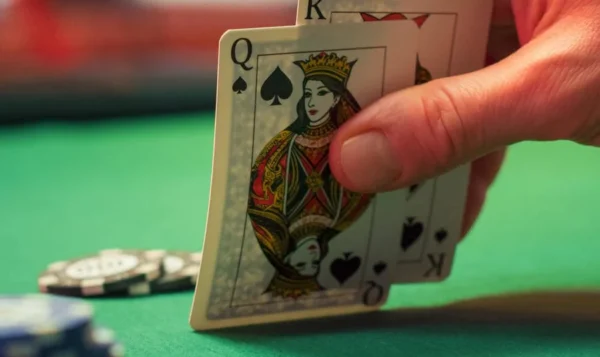
Blackjack feels fair because it lets players make choices. Those choices are real. They also operate within narrow boundaries set by probability.
Studies in behavioural economics have shown that people tend to overestimate the impact of individual decisions in blackjack, attributing outcomes to intuition rather than variance. It might sound irrational but the game is designed to make decision points visible and losses personal.
The dealer, by contrast, follows fixed rules. No judgement. No hesitation. This rigidity is often framed as a disadvantage. Mathematically, it is the opposite. Fixed behaviour makes outcomes predictable at scale, which is exactly what the house wants.
Blackjack on screen
Film and television often uses blackjack as a narrative device. The game appears when writers want tension without explanation. Cards flip. Music swells. Someone counts silently.
In Rain Man, blackjack is used to signal genius, compressing years of probability theory into a montage. The maths is real, but the pace is pure cinema. Casino Royale swaps blackjack for poker, but the logic is the same. Cards become a proxy for character under pressure. In The Hangover, blackjack is played for laughs, with probability reduced to spectacle.
What these scenes omit is the slow accumulation of outcomes. Blackjack drama on screen resolves in minutes. In reality, the mathematics only reveals itself over time. That is less cinematic, but far more honest.
Why blackjack still gets studied
Blackjack endures because it sits at a rare intersection. It is simple enough to explain, complex enough to analyse, and structured tightly enough to produce stable results.
Researchers continue to use blackjack as a teaching tool for probability, expected value, and decision making under uncertainty. It offers clear examples without abstract symbols. You can see the maths in action, card by card.
The dealer acting last is the clearest example of this design philosophy. A single rule that looks neutral, feels fair, and shapes every outcome that follows.