


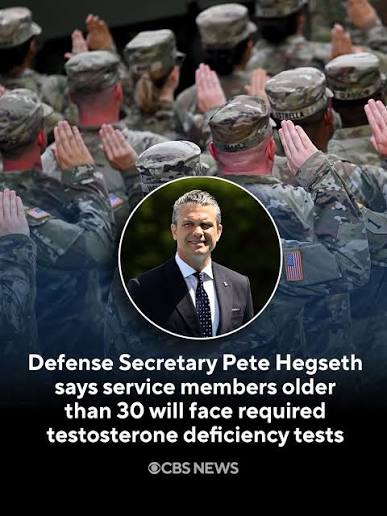
Defense Secretary Pete Hegseth has announced a new Pentagon policy requiring annual screenings for testosterone deficiency for U.S. service members aged 30 and older, calling the initiative a way to keep troops operating at their “absolute best.”
The screenings will become part of routine annual military health assessments. Service members under 30 will have the option to volunteer for testing. Those diagnosed with clinically low testosterone may choose to undergo testosterone replacement therapy (TRT), though treatment will remain voluntary.

In a video announcing the policy, Hegseth said modern warfare places extraordinary physical and mental demands on troops.
“The modern battlefield is brutal and unrelenting,” Hegseth said. “It requires maximum psychological and mental readiness.”
The Defense Secretary has dubbed the effort the “High-T Department of War,” arguing that identifying hormone deficiencies early can improve readiness, resilience, and long-term health without encouraging performance-enhancing drug use.
“We must constantly look for new ways to optimize your performance, your resilience and your long-term health,” Hegseth said of the country’s military in a video on X that was captioned “The High-T Department of War.”
The announcement has sparked immediate debate among medical professionals and lawmakers. Some physicians say testosterone deficiency is a legitimate medical condition that can affect energy, mood, muscle mass, and overall health. Others caution that testosterone testing and treatment should be reserved for patients with confirmed clinical deficiencies, noting that hormone therapy carries potential risks and is not appropriate for everyone.
“This is non-evidence-based and could cause harm,” said Adriane Fugh-Berman, a professor in the department of pharmacology and physiology at Georgetown University.
Critics have also questioned whether the policy focuses disproportionately on men’s health without providing equivalent attention to hormone-related health issues affecting female service members. Others argue that more evidence is needed before implementing universal screening across the armed forces.