

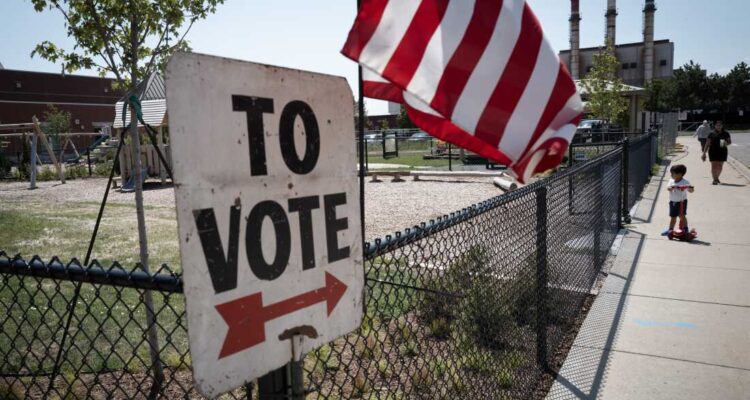
Tuesday’s primary elections produced several surprises that could reshape the political landscape heading into the November midterms, with voters in Florida, Alaska, Wyoming and California sending some clear messages to both Democrats and Republicans.

Perhaps the biggest shock came in Florida, where progressive Democrat Angie Nixon defeated Alex Vindman, the former national security official who became nationally known as a key witness in Donald Trump’s first impeachment. Nixon, a Florida state representative and Democratic socialist, overcame a major fundraising disadvantage to win the Democratic nomination for U.S. Senate. She will face Republican Sen. Ashley Moody in November.
A Progressive Upset in Deep-Red Florida
Nixon’s victory is a major boost for the Democratic Party’s progressive wing. Her campaign focused on issues including universal health care, affordable housing, child care and public education.
But the win also creates a difficult strategic question for Democrats. Florida has become increasingly Republican in recent statewide elections, and Republicans are favored in November. Reuters noted that Nixon’s victory reflects growing frustration among some Democratic voters with the party establishment, while potentially making the general-election fight more difficult for Democrats.
The result also demonstrates that money and establishment backing do not always determine the outcome of a primary.

Trump Still Has Influence — But It Isn’t Absolute
Republican voters gave Trump-backed Rep. Byron Donalds the GOP nomination for governor, putting him on track to face Democrat David Jolly, a former Republican who switched parties.
Donalds’ victory strengthens Trump’s influence in Florida Republican politics. If he wins in November, he would become Florida’s first Black governor.
But Trump also suffered some setbacks. His endorsed candidate Catalina Lauf lost her congressional primary, while several other candidates associated with Trump’s political movement failed to advance. Rep. Cory Mills, who was facing ethics-related scrutiny, also lost his primary.
The broader message: Trump remains a powerful force within the Republican Party, but his endorsement is no guarantee of victory.
Alaska Could Produce One of November’s Most Competitive Senate Races
Alaska delivered another important result. Democrat Mary Peltola emerged as the top vote-getter in the state’s nonpartisan Senate primary, ahead of Republican incumbent Dan Sullivan.
Peltola’s performance puts her in position to make the November race competitive. Alaska uses ranked-choice voting, adding another layer of uncertainty to the general election.
The race also generated unusual confusion because another candidate on the ballot had a name similar to Sullivan’s.
Wyoming Sends Another Signal About the GOP
Wyoming voters also delivered a surprise for Trump.
Eric Barlow won the Republican gubernatorial nomination over Trump-endorsed candidate Megan Degenfelder. Meanwhile, Secretary of State Chuck Gray won the GOP nomination for the House, and Rep. Harriet Hageman won the Republican Senate nomination in a race created by Sen. Cynthia Lummis’ retirement.
The gubernatorial result adds to the evidence that Trump’s preferred candidates can still be vulnerable, even in heavily Republican states.
What Tuesday Really Means
The most important takeaway from Tuesday may be that neither party is completely united.
Democratic voters are continuing to wrestle with the divide between the party establishment and an increasingly energized progressive movement. Nixon’s victory in Florida is the latest example of a progressive candidate breaking through despite being heavily outspent. But more moderate Democrats also won important races, including Jared Moskowitz’s victory over a progressive challenger in Florida.
Republicans, meanwhile, remain strongly aligned with Trump in many places, but Tuesday showed that his endorsement has limits. Some of his preferred candidates won decisively, while others were rejected by Republican voters.
And that could be the biggest lesson heading into November: the 2026 midterms are shaping up to be less predictable than either party would like.